5 Athleisure Office Looks That Work in Early September
Quick Answer: Athleisure reads as office-appropriate when exactly one element is obviously athletic and everything else is structured. In early September, that usually means technical trousers or a knit legging with a tailored top layer and a proper shoe. The failure mode is two or more athletic pieces at once, which reads as a gym outfit regardless of how expensive it is.
Early September is genuinely awkward. It is 26 degrees at lunchtime, the office is air conditioned to 20, and everyone has switched to autumn dressing about three weeks before the weather agrees.

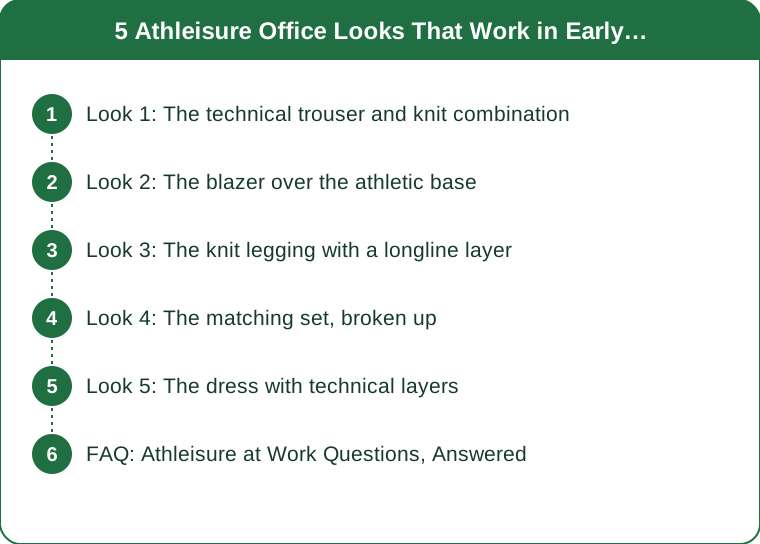
Look 1: The technical trouser and knit combination
The most straightforwardly office-appropriate of the five, and the one that works in the widest range of workplaces.
The pieces: a tailored technical trouser - a straight or wide leg in a four-way stretch fabric with a proper waistband and a crease if possible - with a fine-gauge knit top, and a leather or leather-look loafer.
Why it works: the trouser is the athletic piece, and it is disguised. The silhouette is tailoring; only the fabric is technical. Everything else in the outfit is conventional, so the athletic element registers as comfort rather than as sportswear.
The detail that decides it: the hem and the waistband. A technical trouser with an elasticated hem or a visible drawstring reads as a jogger. A flat waistband and a straight or slightly cropped hem reads as trousers. Same fabric, entirely different classification.
For early September specifically: a fine merino or cotton knit in a short sleeve handles the temperature swing better than a long-sleeved version, because you can add a jacket for the air conditioning and remove it at lunch.
Colours that work hardest: navy, charcoal, and stone. Black technical fabric can read as gym leggings more readily, particularly in a matte finish.
Look 2: The blazer over the athletic base
The classic formula, and the one most people get slightly wrong.
The pieces: a structured blazer - genuinely structured, with a shoulder and a lining, not a soft unlined one - over a fitted technical top or a ribbed vest, with straight-leg trousers or dark jeans and a clean leather trainer or a flat.
Why the structure matters so much: the blazer is doing all the formality work in this outfit. An unstructured, soft blazer over an athletic top gives you two soft pieces, and the whole outfit slides toward loungewear. A blazer with a defined shoulder line reads as tailoring even when everything under it is technical.
Where people go wrong: wearing the blazer over a full athletic outfit - technical top and leggings. That is two athletic pieces and one structured one, and the ratio decides how the outfit reads. One athletic element, maximum.
The shoe carries more weight here than people expect. A running shoe with visible mesh and a chunky sole pulls the whole outfit back toward the gym. A minimal leather trainer, a loafer, or a flat mule holds the line.
Early September note: a blazer in linen-blend or an unlined cotton works when a wool one is too warm, provided it still has a shoulder. Look for structure rather than weight.
Look 3: The knit legging with a longline layer
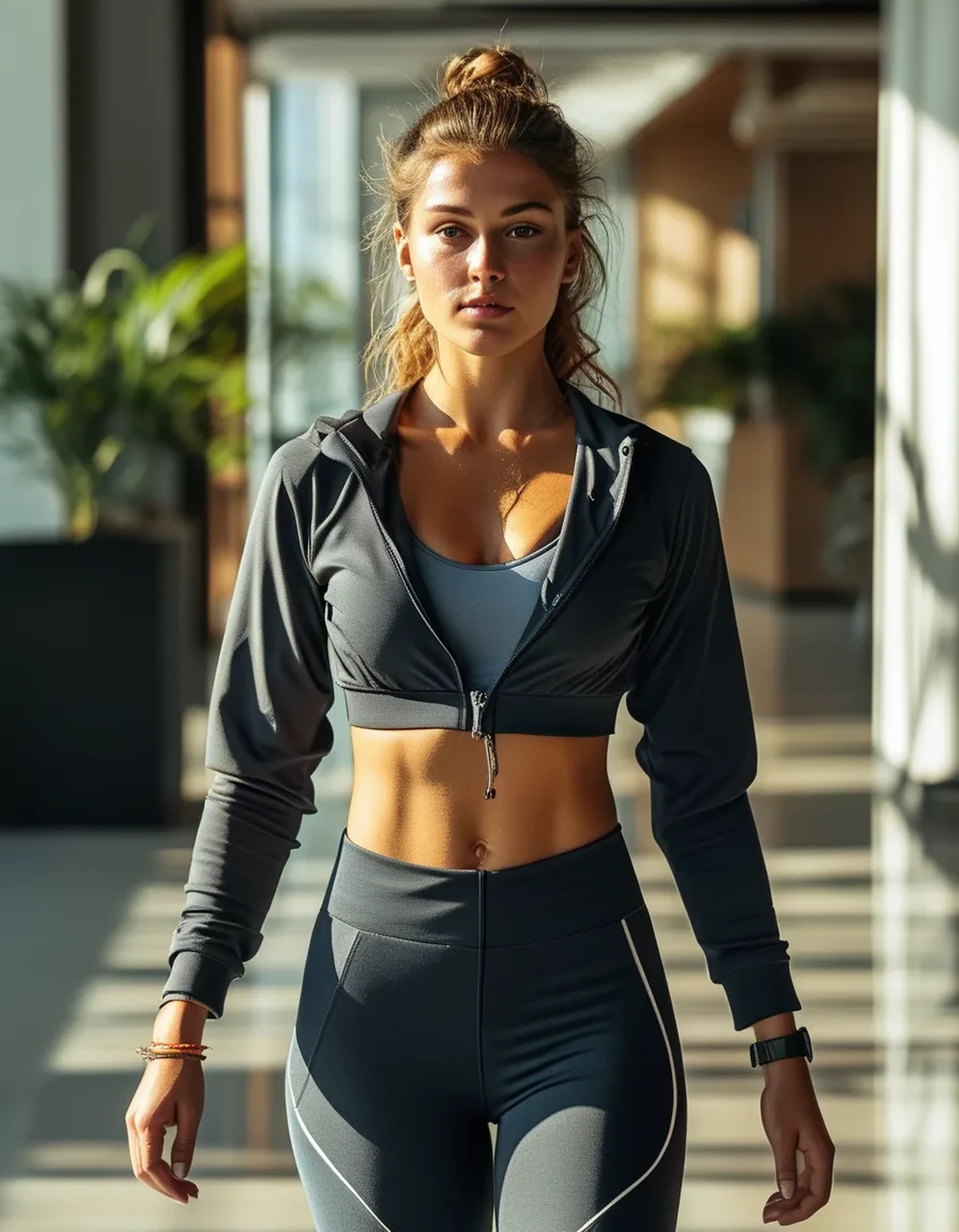
The version for workplaces where leggings are acceptable, and the one that needs the most care.
The pieces: a thick knit or ponte legging - not a shiny compression one - with a longline blazer, coat, or heavy cardigan reaching mid-thigh or below, a structured top underneath, and an ankle boot.
The two conditions that make this work:
Fabric weight. A ponte or thick knit legging is opaque, holds its shape, and reads as a trouser alternative. A thin performance legging with a sheen reads as activewear, unmistakably. This is the single biggest variable in the whole outfit.
Layer length. The top layer needs to be long enough to be deliberate - mid-thigh at minimum. A short jacket over leggings is a gym outfit in most offices; a longline coat over the same leggings is a considered one.
The shoe: an ankle boot in a tone close to the legging extends the line and adds formality. A trainer here tips it back toward athletic, which defeats the layering work.
Know your workplace. This look is fine in a creative or relaxed office and not in a conservative one, and no amount of styling changes that. If in doubt, look 1 does a similar job with far less risk.
Look 4: The matching set, broken up
The most useful trick in the whole category, because it doubles the wardrobe you already own.
The principle: take a matching athletic set - a knit two-piece, a technical co-ord - and wear only one half, pairing it with something conventional.
The two versions:
- Top half: the knit or technical top with tailored trousers or a midi skirt. The top reads as a fine knit rather than as sportswear once it is not next to its matching bottom.
- Bottom half: the trousers with a proper shirt or a structured knit, and a leather shoe.
Why breaking the set works: matching sets read as an outfit that was chosen as a unit, which is exactly what makes them read as leisurewear. Separated, each piece is judged on its own, and a well-made technical piece on its own usually passes easily.
Early September specifically: the top half version handles the temperature problem well - a light knit top with tailored trousers works at 26 degrees, and the matching bottoms would be too warm anyway.
One caution: avoid wearing one half of a very recognisable set. If the set is distinctive enough that people know what it is, half of it still reads as half of it.
Look 5: The dress with technical layers
The lowest-effort option and the best answer to the September temperature swing.
The pieces: a simple knit or jersey midi dress - the athletic element is the fabric, which is comfortable and stretchy - with a structured jacket or a denim jacket, and a flat shoe or a low boot.
Why a dress solves the layering problem: one garment covers the whole body, so you are adjusting only the outer layer as the temperature moves. In an office at 20 degrees and a street at 26, that is much easier than managing a two-piece outfit.
Fabric matters here too. A jersey or knit midi in a matte, substantial fabric reads as a dress. A thin, shiny, or clingy performance fabric reads as a gym dress, which is a different thing entirely.
Adding structure: a belt at the natural waist converts a soft jersey dress into something considerably more defined, and costs nothing. A jacket with a shoulder does the same job from above.
Practical detail for early September: choose a dress with sleeves rather than a sleeveless one if your office runs cold. Managing the air conditioning with the dress itself means you do not have to keep a jacket on at your desk all day, which is more comfortable than the alternative.
FAQ: Athleisure at Work Questions, Answered
What is the one rule if I remember nothing else?
One athletic element, everything else structured. Almost every athleisure outfit that fails at the office fails because it has two or more, and almost every one that works has exactly one.
Are leggings ever acceptable at work?
It depends heavily on the workplace and on the leggings. A thick ponte legging under a longline layer with a proper boot works in many relaxed offices. A thin performance legging does not, anywhere. If unsure, a technical straight-leg trouser gets you the same comfort with none of the risk.
Can I wear trainers to the office?
Minimal leather trainers in a plain colour read as smart casual in most workplaces now. Running shoes with visible mesh, bright colours, or chunky performance soles read as gym shoes and pull the whole outfit with them.
How do I handle the temperature difference between outside and the office?
A structured outer layer you can remove, plus a base you are comfortable in on its own. Dresses and one-piece outfits handle this best because you are only adjusting one thing.
Does expensive athleisure look more office-appropriate?
Only indirectly. Better fabric holds its shape and looks less shiny, which helps. But an expensive legging is still recognisably a legging, and a cheap tailored technical trouser will read as more appropriate than an expensive one that does not.
TL;DR:
- One athletic element, everything else structured - this rule decides almost every outfit
- Technical trousers work best when the waistband and hem look like tailoring, not like joggers
- A blazer needs actual shoulder structure to do its job over an athletic base
- Break up matching sets; separated halves read as ordinary pieces
- The shoe carries more weight than people expect - minimal leather beats performance mesh every time
Early September rewards outfits that adjust in one move rather than five. Pick two of these formulas, keep the ratio right, and the in-between weeks stop being a daily decision.
See It in Motion
Seen here: High Waist Jogger Sweatpants with Pockets — shop it on bubblelime.com
Keep Reading
This article is for general informational and styling purposes only. Fit, sizing, and product availability may vary.