Five Athleisure Office Looks for the Weeks Between Seasons
Quick Answer: The transition weeks are hard because you need three temperature zones in one outfit — a cold commute, a cold office, and a warm afternoon. The five looks below all work the same way: one structured anchor piece that reads as workwear, a soft base you can strip to, and one layer that comes off and goes back on. Structure is what makes athleisure office-appropriate, not fabric.
September dressing for an office is a genuinely annoying problem. It’s 54°F when you leave, 68°F and blasting AC at your desk, and 79°F when you go get lunch.
Here are five outfits that handle all three without a bag full of spare clothing.
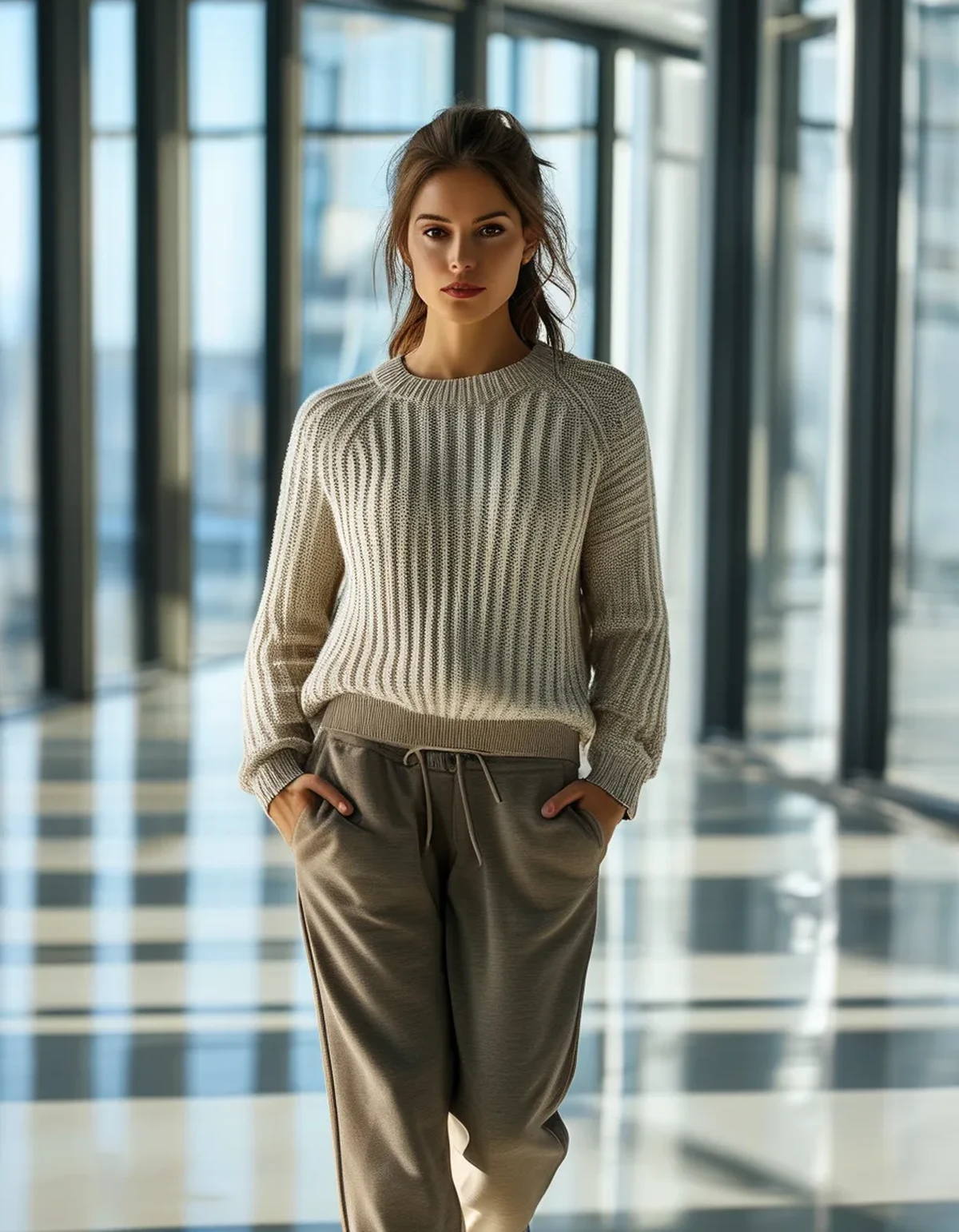
Look 1: The Structured Knit and Tailored Jogger
The workhorse, and the one to build first if you’re only building one.
The anchor: a tailored jogger in a ponte or a heavier crepe — something with a defined crease, a flat waistband, and a tapered leg that ends cleanly at the ankle. The word tailored is doing real work here. A jogger in sweatshirt fleece is loungewear; the same silhouette in a structured fabric reads as trousers.
The base: a fitted shell or a fine-gauge tank in a solid, tucked. This is what you’re down to at 2pm.
The layer: a structured knit — a heavier cardigan with real shoulders, or a knit blazer. Not a hoodie, not anything with a drawstring.
The shoes: a clean leather sneaker or a low block heel. The sneaker is what makes it athleisure; the leather is what keeps it in the building.
Why it works across three temperatures: the jogger is warm enough for a 54°F commute on its own, the knit comes off at your desk, and the fitted base is a complete look for a warm walk at lunch. Nothing needs to be carried but the knit.
Look 2: The Longline Layer Over a Column
For days you have meetings and the first outfit feels too casual.
The anchor: a longline coat or duster hitting mid-thigh or below, in a fabric with enough weight to hang straight. This is the single most useful transitional piece for an office, because an open coat over anything raises the formality of everything underneath by a full step.
The base: a monochrome column — same-color top and bottom. A fitted long-sleeve and a straight-leg legging or slim ponte pant in the same tone. The single-color line is what makes technical fabric read as intentional rather than gym-adjacent.
The layer: the coat itself, worn open. Two vertical front edges, clean line, no belt needed.
The shoes: something with a hard sole. A loafer, a boot, a structured flat. Soft-soled shoes under a longline coat read as errands.
The temperature logic: the coat handles the commute completely, comes off entirely at your desk where the column is the outfit, and goes back on for a cold lobby. This is the look for a day where you’ll move between buildings.

Look 3: The Half-Zip and Wide Trouser
The most comfortable of the five and the one that looks most current.
The anchor: a wide or straight-leg trouser in a technical or ponte fabric, full length, breaking just at the shoe. Volume on the bottom is what balances a fitted top and keeps the proportions from reading as workout gear.
The base: a fine-knit half-zip or a mock neck in merino or a merino blend. Merino is the actual solution to the three-temperature problem — it regulates across a wide range and doesn’t hold odor, which matters when the AC and the afternoon disagree by fifteen degrees.
The layer: optional, and if you add one, a light shell or an unstructured jacket you can roll into a tote.
The shoes: a flat with some presence — a loafer, a sleek sneaker, an ankle boot once it’s genuinely cold.
Why merino matters here: a cotton or synthetic top in an over-air-conditioned office means you’re cold all morning, and the same top at lunch means you’re damp. Merino is the fiber that handles both, and one good piece replaces two mediocre ones.
Look 4: The Dress With Structure On Top
For the day when getting dressed needs to take four minutes.
The anchor: a simple knit dress — a T-shirt dress, a ribbed midi, a fitted sheath in a jersey — in a solid dark or mid tone. On its own this is a weekend piece. That’s fine; it isn’t going to be on its own.
The layer that does everything: a structured jacket or a firm knit blazer over it. This is the entire trick. A soft dress under a structured shoulder is office-appropriate; the same dress without it isn’t.
The temperature answer: opaque tights once mornings drop below the mid-50s, bare legs while they don’t. Tights are the transitional lever most people forget — the same dress works across a twenty-degree range depending on what’s on your legs.
The shoes: an ankle boot with a low block heel is the most forgiving option and works from September through March.
The bonus: it packs. If you have an evening thing, the jacket comes off and the dress is a different outfit, which none of the other four looks can claim.
Look 5: The Vest Solution
The most useful piece nobody buys, and the one specifically designed for this exact temperature problem.
The anchor: a knit or quilted vest — sleeveless, hitting at the hip or slightly below.
Why a vest: the transition-week problem is that your core is cold and your arms aren’t. A vest solves exactly that, weighs almost nothing, and doesn’t have to come off when the office warms up because it isn’t warm enough to be uncomfortable. It’s the only layer on this list you can wear all day without thinking about it.
The base: a long-sleeve fitted top and a straight pant or a dark legging. Because the vest adds the visual structure, the base can be genuinely simple.
The layer: in the morning, a coat over the vest. By 10am, the coat is on a hook and the vest is doing the work.
The shoes: whatever the rest of the outfit calls for — the vest is neutral.
One styling note: a vest reads best when there’s a clear waist definition or a clean vertical line beneath it. Over a very loose top it adds bulk; over a fitted one it adds shape. And a longer vest over a slim base is one of the few reliable ways to layer without adding visual width anywhere.
TL;DR:
- The transition problem is three temperatures in one day — cold commute, cold office, warm afternoon.
- Structure is what makes athleisure office-appropriate, not fabric. A defined shoulder or a crease does more than price does.
- Merino solves the AC-versus-afternoon problem better than any layering trick.
- Tights turn one knit dress into a twenty-degree range.
- A vest is the only layer you can wear all day without adjusting — the most underrated transitional piece.
Build the structured knit and tailored jogger first. It covers four days out of five and everything else is a variation on it.
See It in Motion
Seen here: Super High Waist Embossed Yoga Leggings with Inner Pocket — shop it on bubblelime.com
Keep Reading
This article is for general informational and styling purposes only. Fit, sizing, and product availability may vary.